What Makes a Controlled Atmosphere Storage Building Different from Cold Storage
Controlled atmosphere storage buildings in BC work differently than cold storage. MSC explains the real difference and what it means for your build.

Sunny Valley Fruit, Keremeos, BC. A temperature-regulated steel building shell built by MSC in a Similkameen Valley wind tunnel, on time and on budget, so the technical teams could move in and build the climate-controlled storage rooms without delay.
By the Metal Structure Concepts Team | June 2026
This article is based on a conversation with Steve Ivanitz, Co-owner of MSC Steel and third-generation steel builder with 25+ years of experience in pre-engineered agricultural and commercial builds across Western Canada.
Controlled atmosphere storage buildings in BC aren't the same as cold storage buildings, which is a surprise to a lot of people. The difference completely changes how the building gets designed, who needs to be involved, and what the whole thing costs. We connected with MSC co-owner Steve Ivanitz to get a clear idea of how both systems work, and what MSC has learned building them across the Okanagan and Interior BC.
Quick Answer
Cold storage: A whole-building system. Insulation, vapour barriers, and mechanical equipment keep the entire building at a consistent low temperature.
Controlled atmosphere (CA) storage: Sealed rooms built inside a standard building shell. The rooms strip oxygen from the air to preserve fruit. You can't enter an operating CA room safely without going through a depressurization process first.
How they get built: MSC builds the outer shell. A CA specialist builds the sealed rooms inside. Both need to be in the conversation before the building is sized.
Cost: CA rooms cost significantly more than cold storage. Many growers build a mix of both in the same building.
Cold Storage: How the Building Itself Works
Cold storage is a building designed to stay cold. Think of a cold beer and wine store. The whole space is refrigerated, and the structure holds that temperature year-round.
The major change that happens when we’re building a cold storage build is the vapour barrier. In a regular building, the interior is warmer than the exterior for most of the year, so the vapour barrier goes on the inside of the insulation. Flip that: in a cold storage building, the inside is the cold side year-round, so the vapour barrier moves toward the exterior. Get that wrong, and you'll get moisture problems in your walls.
"The building itself for cold storage is different. If you do a cold storage building properly, your vapour barrier is close to the outside of the building. The walls and the roof are built a bit different because the inside is cold all year long, and that's the temperature you're trying to control." — Steve Ivanitz, Co-Owner, Metal Structure Concept
Insulated metal panels are the right system for cold storage. They've been used in meat lockers and cold storage since the 1960s because they manage airflow and thermal performance in both directions. MSC built the entire envelope of the Farming Karma Fruit Company project in Kelowna as a climate-controlled steel warehouse (insulated metal panels throughout) so Farming Karma could use any part of the building for cold storage as their operation grew.
"They have to be built right," Steve says. "They function way better with the proper panels."
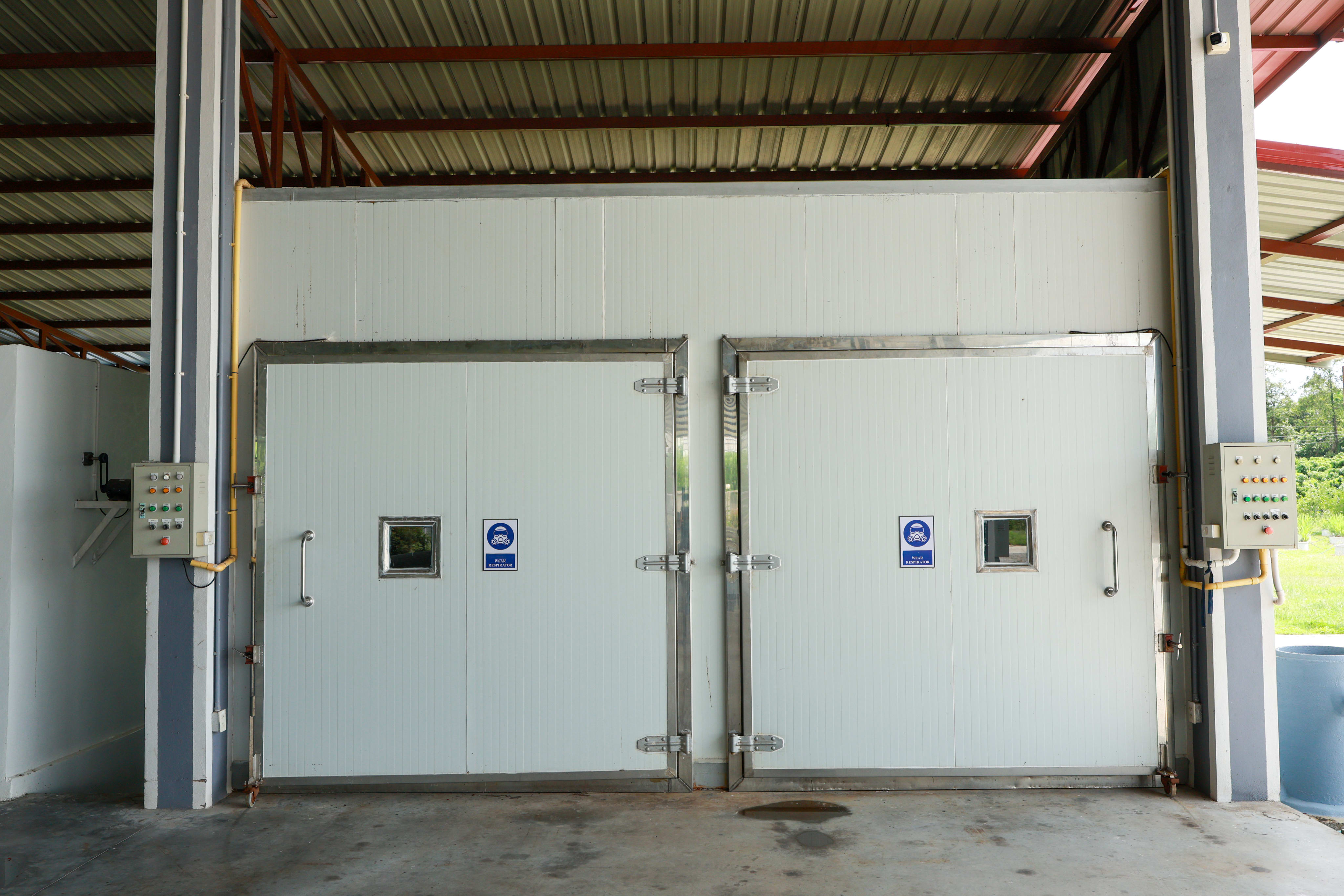
A controlled atmosphere storage freezer room in a commercial warehouse factory facility. CA ensures a sterile and efficient atmosphere for modern food preservation.
Controlled Atmosphere Storage: A Sealed Room Inside a Building
CA storage goes further than cold storage. Instead of just lowering the temperature, a CA room removes most of the oxygen from the air. Fruit breaks down when it's exposed to oxygen… take that away, and tree fruit can be stored well beyond what cold temperature alone can do.
Here's something most people don't know going in: you can't walk into an operating CA room. The atmosphere inside won't support a person. There's an airlock, a switch to flip, and a wait before it's safe to enter.
"They suck the air out of the room," Steve says. "You and I can't go in the room… you're dead. There's some chemical air stuff that happens in there. They're super sealed. That's how they preserve the fruit. It's because there's no air deteriorating it."
Because of how airtight a CA room has to be, nobody builds the whole building as a CA structure. A standard building, even a well-built one, has too many places where air moves through connections, frames, and wall assemblies. A CA room needs a level of sealing a standard building envelope can't get to.
"No building guy that I know of goes and builds the whole building as a controlled atmosphere building," Steve says. "You're chasing your tail. There are too many air leaky spots in an average building. Even if it's built perfect and you think it's nice, it still doesn't work."
The building and the CA rooms are 2 separate things, built by 2 separate trades.
Two Trades, One Project
A CA storage facility gets built in 2 stages.
MSC builds the outer shell: a standard pre-engineered steel building with conventional insulation and a good roof. But the height, width, layout, and structural allowances are planned specifically around the CA rooms that go inside. How many rooms the grower wants determines the size of the building. Change that number after the building is up and you've got a problem.
"We build a very basic, standard, traditional building. A good roof, standard insulation," Steve says. "Then they go inside and build a controlled atmosphere separate, standalone room with insulated metal panels. We need to be heavily involved in the building design to suit the controlled atmosphere. There is some specific design stuff in the height, the width, and the layout. The more we're involved at the start, the better the end result for the client."
The CA rooms are built inside the shell by a specialist. In the Okanagan, MSC works with Migiel Besseling of Besseling Construction in Oliver, BC. His company builds the sealed rooms, installs the atmosphere control systems, the gas monitoring, and the airlock entries. The rooms aren't a fixed size; they're designed around how many bins of fruit need to fit and what atmosphere conditions the crop requires.
Most Okanagan growers who want CA storage already know Migiel. They call him first. He calls MSC. The building gets designed around what the rooms need, not the other way around.
"Migiel at Besseling Construction is a very picky engineer, and he does a great job. He talks in millimetres! That's why I recommend him.” — Steve Ivanitz
Why Most Growers End Up with a Mix
CA rooms are expensive. The sealing, the atmosphere control systems, the specialist labour, etc. all adds up fast. A lot of growers who'd love to go all-in on CA end up building a mix: some CA rooms for their highest-value fruit, some cold storage rooms for the rest.
"CA and cold storage often go together," Steve says. "CA is so expensive. Sometimes they'll try for both, like they'll have three cold storage rooms and three CA rooms when they truly wanted six CA rooms."
That's not a compromise so much as a planning conversation. What are you growing, what shelf life do you need, and what's your budget? The balance looks different for every operation. MSC can help work through it early, before the building gets sized and the CA specialist is brought in to spec the rooms.
And one thing Steve's clear about: don't try to save money in the wrong places.
"Cheaping out is a poor decision," he says. "A realistic budget and not cutting corners… that's the advice. Location, size, the design… it all makes a huge difference."
MSC Controlled Atmosphere & Cold Storage Buildings in the Okanagan
MSC has completed farm steel buildings for growers across the Okanagan, including Kalsam Orchards in Kelowna and Sunny Valley Fruit in Keremeos, both built as food storage steel buildings designed around climate-controlled storage systems.
The Kalsam Orchards building is a 7,350 sq ft pre-engineered steel structure with a 105-foot clearspan interior and a standing seam roof, erected in 20 days. No interior columns means the fit-out team gets a clean, open floor plan from day one.
At Sunny Valley Fruit in Keremeos, MSC built the shell quickly so the technical teams could start the interior rooms without delay. On CA projects, sequencing matters. The sooner the shell is closed in, the sooner the specialist can get to work.
"The finished product was really good, and we're very happy with the quality and finish of the building." — Steve Day, Kalsam Orchards.
Questions to Answer Before you Build
The most common mistake on CA projects is treating the building and the rooms as 2 separate decisions. They're not. The building has to be designed around the rooms from the start.
Before you talk to a building supplier, have a rough sense of:
How many CA rooms do you want, and roughly how many bins each room needs to hold
Whether a mix of CA and cold storage makes sense for your operation and budget
What you're storing and what atmosphere conditions it needs
You don't need final answers before you pick up the phone. But you do need both your building supplier and your CA specialist in the same conversation early. Bringing them in one after the other is where buildings end up the wrong size.
"If you're going to build a controlled atmosphere building, there needs to be a proper design, a proper team," Steve says. "MSC knows the people and the know-how. We're not the CA experts, but we know who to call, and we can give advice on how it functions with our building."
FAQ
What's the difference between cold storage and controlled atmosphere storage? Cold storage is a whole-building system that holds a consistent low temperature using insulation and mechanical equipment. Controlled atmosphere storage uses sealed, oxygen-depleted rooms built inside a standard building shell to preserve fruit beyond what refrigeration alone can do. They're different systems, and often built together in the same facility.
Does MSC build the CA rooms? No. MSC builds the outer shell of the building, designed to suit the CA rooms that go inside. The sealed rooms are built by a CA specialist. In the Okanagan, MSC works with Besseling Construction in Oliver, BC. Both trades need to be involved before the building is designed.
How does the room count affect the building size? The number of CA rooms determines the building dimensions, not the other way around. Room size is based on how many bins of fruit need to be stored and what atmosphere conditions the crop requires. MSC and the CA specialist work through those dimensions together before the building is designed.
Is CA storage more expensive than cold storage? Yes, significantly. The sealing, atmosphere control systems, and specialist labour involved in CA rooms cost considerably more than standard cold storage. Many Okanagan growers build a mix of CA and cold storage rooms in the same building to balance cost against crop requirements.
Where does MSC build CA and cold storage facilities? MSC builds across British Columbia, Alberta, Saskatchewan, and Northern Canada. Most CA storage work has been in the Okanagan and Interior BC, where tree fruit growing is concentrated.
Talk to MSC Before You Size the Building
The building design and the room plan have to happen together. MSC has worked on temperature-regulated storage projects across the Okanagan and Interior BC and knows who to bring in for the CA side.
Talk to an MSC project lead before you start.
Metal Structure Concepts supplies and installs pre-engineered steel buildings for agricultural, commercial, and industrial clients across British Columbia, Alberta, Saskatchewan, and Northern Canada. Based in Kelowna, BC, MSC specializes in farm storage buildings for fruit growers and agri-business operations throughout the Okanagan and Interior BC. Learn more at mscsteel.com.