Building Canada: Shaping the Mining Industry with Mining Steel Buildings
Mining is one of Canada’s top industries. Get a better understanding of how mining steel buildings can help this crucial Canadian industry thrive in our Building Canada series.
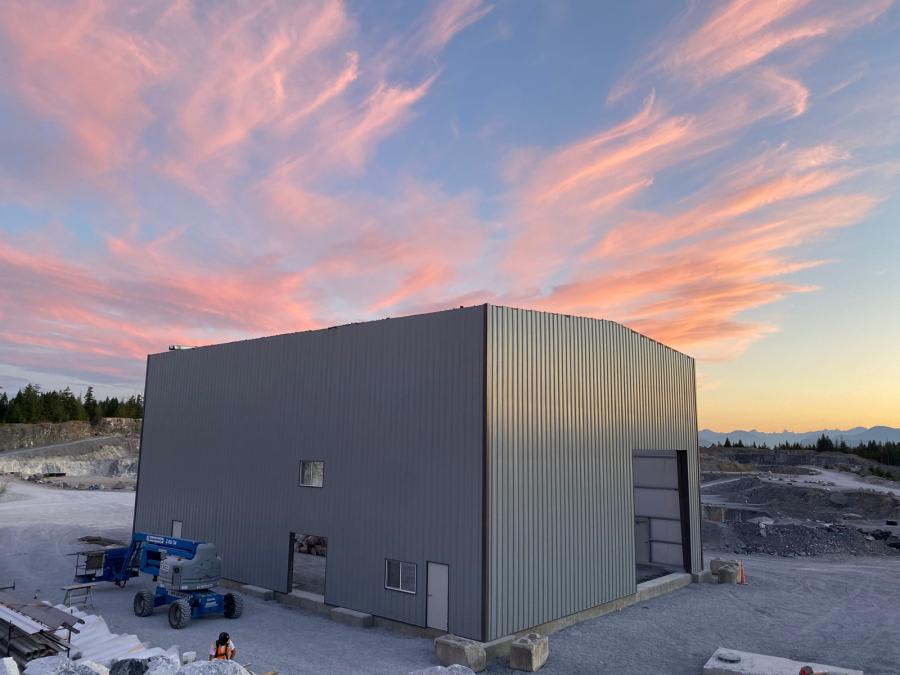

This mining steel building for Imperial Limestone Ltd. is a feat of logistics — demanding two ferries and coordination between three different parties to be erected on the 300 km Gulf Island, Texada in British Columbia.
Canada’s economy consists of a wide variety of diverse industries, but one thing that many of these fields have in common is benefiting from pre-engineered steel buildings.
MSC has been building Canada for over 20 years by supporting homegrown industry — both large and small — through steel structures.
In our new Building Canada series, we shine a spotlight on one of those industries to showcase its contributions to Canada, and how pre-engineered metal buildings help those businesses succeed by being built strong, built right, and built Canadian.
Mining in Canada
As one of Canada’s most important economic sectors, mining is a perfect place to begin our series.
Mining does a lot for Canada. Here are just some of its contributions in 2022:
- $109 billion to Canada’s gross domestic product
- Mineral production valued at $74.6 billion
- 420,000 people employed directly
- 274,000 employed indirectly
What we’re mining
The Canadian mining industry is about as vast as our country is large, producing 60 minerals and metals at almost 200 mines and 6,500 sand, gravel and stone quarries in 2022. Canada ranks among the top five global producers of diamonds, gemstones, gold, indium, niobium, platinum group metals, titanium concentrate and uranium.
We’re far from a jack-of-all-trades, however. Here’s a closer look at some of the top exports produced in Canada.
Potash
Canada is the number one producer and exporter of potash in the world — a mineral compound used to create fertilizer, which plants love.
Fertilizers support plant growth, increase yields, promote disease resistance and help preserve water for crops.
The hot spot for potash production is in one of our favourite provinces: Saskatchewan, where all 11 of Canada’s active potash mines operate.
Born in B.C., MSC opened a second Alberta and Saskatchewan province in 2023, headed by co-owner Corey Ivanitz to truly embed themselves in our Western Canadian home.
Gold
Canada’s most valuable mined commodity (and perhaps the most glamorous), gold production was valued at just over $15 billion in 2023.
We’re the fourth-largest gold producer in the world, and we mine it from ten provinces and territories in the country.
While jewelry is the number one driver, technology like microcircuitry also contributes to the global demand for gold.
Coal
Western Canada is the epicentre of Canadian coal mining, with the majority being produced in B.C., Alberta, and Saskatchewan. While coal is often used to generate electricity, it’s also used in steel manufacturing.
Iron ore concentrates
Canada is home to some of the highest quality iron ore concentrates, which we mine from Quebec, Newfoundland and Labrador, and Nunavut. Being of such high grade makes our iron ore ideal for manufacturing green steel.
Primary aluminum
Canada is the fourth-largest producer of primary aluminum in the world, after China, India, and Russia.
Aluminum is actually extracted from bauxite ore, which is imported into the country. Out of the 10 primary aluminum smelters in the country, nine are found in Quebec (bonjour!) and the tenth is in Kitimat, BC.
Among the major aluminum producers, Canada has the lowest carbon footprint, thanks to hydroelectricity and cutting-edge technologies.
Infrastructure challenges
Not only is mining a longstanding, valuable industry in Canada, but the sector also continues to hold potential for future exploration.
One of the most prominent challenges faced by the industry, however, involves infrastructure. While northern Canada faces many of these hurdles, they are not unique to the region. Mines can often be found in hard-to-access locations (or even on islands, as we experienced for Imperial Limestone Ltd.).
The most remote mining projects cost as much as six times that of the least remote, according to the Mining Association of Canada.
Infrastructure challenges in mining include:
- Energy access
- Cost
- Transportation
- Remoteness
Industrial mining buildings benefits
While industrial mining buildings can’t solve every infrastructure challenge faced by the mining industry, they can certainly help — particularly in remote regions like northern Canada.
Remote locations
Northern Canada is about as remote as it gets. Infrastructural challenges, including accessibility, can make it difficult for less experienced builders to work in the north — but MSC loves a challenge. We have the right expertise and drive to handle complex steel building projects in remote locations.
The key: mastering logistics and relationship building. As a full-service steel building company, we’re able to take a remote project from concept to completion from management, design, supply, and installation as far north as Iqaluit.
Steel buildings are an excellent choice for remote locations as they can be erected quickly, are very low maintenance, and are resilient to extreme weather, among other benefits.
→ The proof: Going the distance for Imperial Limestone Ltd.
When Imperial Limestone Ltd. needed a steel building on Texada Island in B.C. — a gulf island location requiring complex logistics like ferry times and material transportation by water — we rose like the tide to the challenge!
The building was erected in a rock quarry and required clear and constant communication between our team, a crane supplier, and the client. The 4,800-square-foot building was completed without a hitch in one of the more unique and logistically challenging locations we’ve had the pleasure of working in.
Low energy use
Steel buildings are very well insulated, lowering the overall energy use of the building. In locations where energy availability is an issue, this is a highly important feature for lowering the footprint of the building.
Not only will industrial mining buildings perform efficiently with lower energy use, but superior insulation protects the building’s content from mould and corrosion caused by temperature fluctuations.
Extreme weather
From the frigid temperatures in the Yukon to the record-breaking heat experienced in summer, steel buildings are up to the task.
Their resilience goes beyond the thermometer, however. Pre-engineered steel buildings are resistant to many effects of extreme weather events, from fires to earthquakes, hail storms and flooding. That’s because steel is:
- Highly ductile
- Fire resistant
- Non-combustible
- Rust and corrosion-resistant
- Strong compared to its weight (high strength-to-weight ratio)
→ The proof: A truck shop for Victoria Gold Corp
Mining giant Victoria Gold Corp. needed truck storage for their mining operation in Whitehorse, Yukon. MSC custom-built a 14,070-square-foot shop featuring insulated metal panels for the roof and walls, a custom-sealed wash bay with epoxy columns, heavy-duty industrial door canopies, and more.
Cost-effective
Steel buildings are one of the most cost-effective solutions for a business. Not only are the structures affordable, but the quick build times mean you can be back to business sooner. Additionally, durability and low maintenance mean lower operational costs in the long run.
Low maintenance
Steel buildings require little maintenance once erected. The set-it-and-forget-it nature of steel buildings makes them ideal for far-away locations where accessing services may be challenging.
Versatile
Steel buildings are like a well-insulated blank canvas, making them very versatile. From storage to community centres, the uses are endless, making them a great choice to live in remote communities.
Metal Structure Concepts has been designing and constructing steel buildings across Canada for over 20 years. From retail spaces to warehouses to wineries and more, we are the experts for your next project.Contact us today for a free quote.